
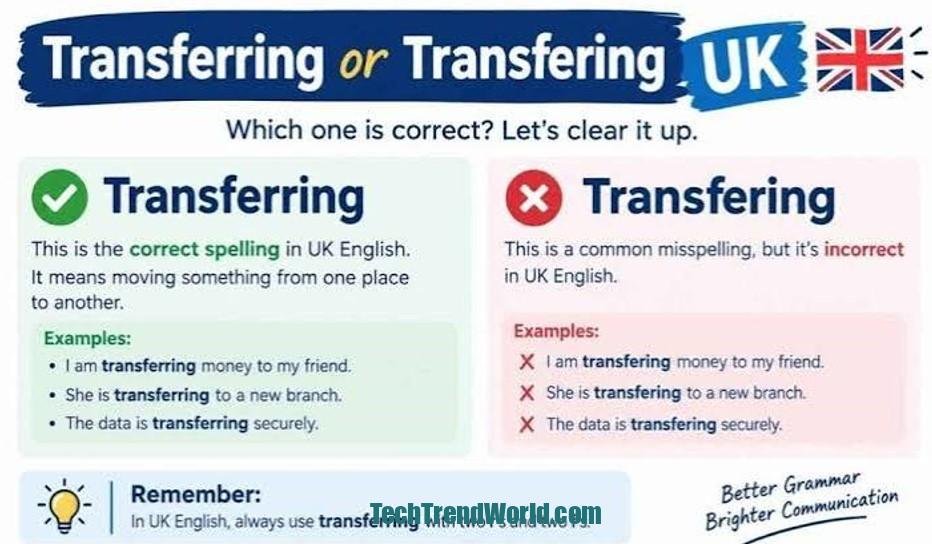
If you have ever paused while writing an email to wonder whether you should type transfering or transferring, you are not alone. English spelling is famous for its confusing rules, hidden exceptions, and tricky suffixes. Adding an “-ing” to the end of a word seems simple until you have to decide whether to double the final consonant.
Here is the quick answer: The correct spelling is transferring. The version with a single “r” (transfering) is always incorrect.
But simply knowing the right answer does not help you with similar words in the future. Why does “transfer” get a double “r” when a word like “offer” only gets one? Understanding the mechanics behind this spelling rule will instantly improve your writing, helping you avoid embarrassing typos in your professional emails, academic papers, and text messages.
In this comprehensive guide, we will break down the exact grammar rules that dictate when to double the “r,” explore related words in the “transfer” family, and provide expert tips to ensure you never make this spelling mistake again.
Which is Correct: Transfering or Transferring?

When choosing between transfering or transferring, you must always use the spelling with two “r”s. Transferring is the only accepted spelling in the English language, regardless of whether you are writing in American English, British English, Canadian English, or Australian English.
The word functions as the present participle or gerund form of the verb “transfer.” It describes the ongoing action of moving someone or something from one place to another.
Correct Example: I am transferring the funds to your bank account right now.
Incorrect Example: She is transfering to a new university next semester.
Despite being universally incorrect, “transfering” remains one of the most common spelling mistakes typed into search engines and word processors. This happens because the human brain looks for patterns. We see words like “suffering” or “offering” and logically assume that “transfer” follows the exact same pattern. However, the English language relies heavily on pronunciation to dictate its spelling rules.
The Grammar Rule Behind the Double ‘R’
To understand why transferring has two “r”s, we need to look at a fundamental English spelling guideline often called the Doubling Rule or the 1-1-1 Rule.
The Doubling Rule helps writers know when to double the final consonant before adding a suffix that begins with a vowel (like -ing, -ed, or -er). You double the final consonant if the root word meets these three conditions:
- One Syllable (or specific multi-syllable traits): The word ends in exactly one consonant.
- One Vowel: That final consonant is preceded by exactly one vowel.
- One Stress: For words with more than one syllable, the stress (or verbal emphasis) must fall on the final syllable.
Let us apply this rule to the word transfer.
- Does it end in one consonant? Yes, it ends in “r.”
- Is there one vowel before it? Yes, the “e” comes right before the “r.”
- Is the stress on the final syllable? Yes. When we say the word, we pronounce it as trans-FER.
Because “transfer” meets all the requirements of the doubling rule, we must double the final consonant before adding the “-ing” suffix. Therefore, it becomes transferring.
Syllable Stress: The Key to the Puzzle

The most confusing part of the doubling rule is the concept of syllable stress. Syllable stress refers to the part of the word that you say the loudest or with the most emphasis.
If you get the syllable stress wrong, you will likely spell the resulting word incorrectly. Let us look at how syllable stress changes the spelling of different verbs ending in “er.”
When the Stress is on the Final Syllable
When you place your vocal emphasis on the end of the word, you double the consonant.
- Confer: The emphasis is con-FER. Therefore, we write conferring.
- Prefer: The emphasis is pre-FER. Therefore, we write preferring.
- Defer: The emphasis is de-FER. Therefore, we write deferring.
- Refer: The emphasis is re-FER. Therefore, we write referring.
When the Stress is on the First Syllable
When you place your vocal emphasis on the beginning or middle of the word, you do not double the consonant.
- Offer: The emphasis is OF-fer. Therefore, we write offering.
- Suffer: The emphasis is SUF-fer. Therefore, we write suffering.
- Differ: The emphasis is DIF-fer. Therefore, we write differing.
- Answer: The emphasis is AN-swer. Therefore, we write answering.
Once you understand how pronunciation connects to spelling, you will never have to guess whether a word needs a double letter again. If you emphasize the end of the word, double it up!
Comparing “Transferring” to Similar Words
It helps to see transferring in the context of other similar words. English relies heavily on suffixes to change the tense or function of a base word. Let us look at a few comparisons to cement this concept.
Traveling vs. Transferring

This is a fascinating comparison because it highlights the difference between American and British English.
In American English, the word “travel” is stressed on the first syllable (TRAV-el). Because the stress is at the beginning, Americans do not double the “l.” They spell it traveling.
However, in British English, the rule is slightly altered for words ending in “l.” British writers double the “l” regardless of the syllable stress, resulting in travelling.
Transferring, on the other hand, is stressed on the final syllable. Because of this, it is spelled with a double “r” in both American and British English. There is no regional variation for this word.
Programming vs. Targeting
The word “program” receives emphasis on the first syllable (PRO-gram). Technically, based on the strict rules of American English, it should only have one “m.” However, due to its origins and early usage, it is universally spelled as programming.
Conversely, “target” is stressed on the first syllable (TAR-get). Following the standard rule, it does not double the final consonant, resulting in targeting.
Common Contexts for Using Transferring
The word transferring is incredibly versatile. You will encounter it across a wide variety of industries and daily situations. Here are the most common contexts where you must ensure you are using the correct spelling.
Financial and Bank Transfers
In the modern digital age, moving money is a daily occurrence. The banking and finance sectors rely heavily on this terminology.
- Example: “I am currently transferring the funds via wire to your checking account.”
- Example: “The app is transferring your balance to the high-yield savings account.”
College and University Admissions
Students frequently move between educational institutions. The academic world uses this term to describe the movement of credits or enrollments.
- Example: “She is transferring from a community college to a four-year university.”
- Example: “We are in the process of transferring your course credits to the new system.”
Technology and File Sharing
If you work with computers, smartphones, or network systems, you see this word on loading screens constantly.
- Example: “Please do not turn off your device while the system is transferring data.”
- Example: “The server is transferring the large video files at maximum speed.”
Workplace and Employee Relocation
Human resources departments use this terminology when employees change roles, departments, or physical office locations.
- Example: “Corporate is transferring the regional manager to the New York branch.”
- Example: “We are transferring your department to the newly renovated building downtown.”
Other Words in the Transfer Family
The spelling rules we discussed do not just apply to the “-ing” suffix. They also apply to other suffixes added to the base word “transfer.” Let us look at the broader word family.
Transferred (Past Tense)
Because the rule applies to suffixes starting with a vowel, the “-ed” suffix also triggers the double “r.” The past tense of transfer is transferred.
- Correct: He transferred the money yesterday.
- Incorrect: He transfered the money yesterday.
Transferable vs. Transferrable
This is where English gets a bit complicated. Both spellings exist, but they have different levels of acceptance.
When adding the “-able” suffix, the syllable stress actually shifts back to the first syllable for many speakers (TRANS-fer-a-ble). Because the stress shifts away from the final syllable of the root word, the single “r” becomes standard.
- Standard: Transferable (e.g., The tickets are non-transferable).
However, you will occasionally see “transferrable” in legal documents. While most dictionaries prefer the single “r,” the double “r” variant is generally accepted as a secondary spelling. To be safe, always stick to transferable.
Transference
“Transference” is a noun used primarily in psychology. Notice what happens to the pronunciation when we say this word: trans-FER-ence shifts to TRANS-fer-ence in some dialects, but more importantly, the suffix “-ence” dictates its own historical spelling rules.
- Standard: Transference (Always spelled with one “r”).
Transferral
A “transferral” is the act of transferring something. Because the emphasis remains heavily on the second syllable (trans-FER-al), the “r” is doubled.
- Standard: Transferral (Always spelled with two “r”s).
The Professional Impact of Spelling Mistakes
You might wonder why it matters if you accidentally type transfering instead of transferring. After all, the reader still knows exactly what you mean.
However, in professional contexts, spelling accuracy is a major indicator of Expertise, Experience, Authoritativeness, and Trustworthiness (EEAT). Your writing is often the first impression you make on a potential employer, a new client, or a business partner.
- Resumes and Cover Letters: A hiring manager reviewing a resume might see “transfering” as a lack of attention to detail. If a candidate claims to have strong communication skills but misspells common verbs, it damages their credibility.
- Business Proposals: If you are asking a client to trust you with a large budget, spelling errors in your pitch deck can make your company appear unprofessional or careless.
- Legal Documents: In legal writing, precision is paramount. A misspelled word can occasionally lead to confusion regarding the intent of a clause, though it is mostly an issue of professional polish.
Taking the extra second to verify your spelling ensures your message is judged on its ideas, not its grammatical flaws.
Comparison Table: Correct vs. Incorrect Forms
To serve as a quick visual reference, here is a chart comparing the correct and incorrect forms of the “transfer” word family.
| Word Form | Correct Spelling | Incorrect Spelling | Why it is Correct |
| Present Participle | Transferring | Transfering | Stress on the final syllable (trans-FER) |
| Past Tense | Transferred | Transfered | Stress on the final syllable (trans-FER) |
| Adjective | Transferable | Transferrable (Less common) | Stress shifts to first syllable (TRANS-fer-able) |
| Noun (Act of) | Transferral | Transferal | Stress remains on second syllable |
| Noun (Psychology) | Transference | Transferrence | Established historical spelling |
Pros and Cons of Relying on Spell Checkers
In the modern era, most people rely on built-in spell checkers, autocorrect, and AI writing assistants to catch mistakes like “transfering.” While these tools are incredibly helpful, relying on them exclusively has both advantages and drawbacks.
Pros
- Speed: Autocorrect fixes “transfering” to “transferring” instantly, saving you time.
- Convenience: You do not have to memorize complex grammar rules like syllable stress.
- Catching Typos: Tools easily catch “fat-finger” typing errors where you simply missed a key.
Cons
- Context Blindness: Sometimes spell checkers change a word to something entirely wrong based on context.
- Over-reliance: If you write on a whiteboard, fill out a paper form, or type on a system without spell check, your lack of foundational knowledge will be exposed.
- Inconsistent Rules: Some spell checkers struggle with regional variations (like traveling vs travelling) and might mark a correct word as incorrect depending on your language settings.
Learning the syllable stress rule ensures you are in total control of your writing, regardless of the technology you are using.
Expert Tips to Remember the Correct Spelling
If you still struggle to remember whether it is transfering or transferring, use these mnemonic devices and expert tricks to lock the correct spelling into your memory.
- The “Ring” Trick: Think of the word “ring.” When you are moving money, you want the bank to “ring” you to confirm. Transfe-ring. Notice that leaves you with only one “r” from the base word. To keep the base word “transfer” intact AND add “ring,” you need two “r”s.
- Clap It Out: Say the word out loud and clap on the loudest syllable. Trans-(clap)FER. Because you clapped on the end of the word, double the last letter!
- Compare it to “Offer”: Whenever you are unsure, think of the word “offering.” You know “offering” has one “r”. You know “transferring” sounds different at the end. Therefore, it must be spelled differently.
- Create a Mental Image: Visualize two “R”s physically picking up a box and moving it (transferring it) to a new location. You need two people (two R’s) to do the heavy lifting of a transfer.
Frequently Asked Questions (FAQ)
1. Can I use “transfering” in informal text messages?
Even in casual texting, “transfering” is technically a misspelling. While your friends will understand what you mean, most modern smartphone keyboards will automatically autocorrect it to “transferring.”
2. Is “transfering” the British spelling?
No. The spelling “transferring” with a double “r” is standard across all variations of the English language, including British, American, Canadian, and Australian English.
3. Why does “offering” only have one R?
The word “offer” places the vocal emphasis on the first syllable (OF-fer). According to the doubling rule, you only double the final consonant if the stress is on the final syllable. Because the stress is at the beginning, the “r” is not doubled.
4. What is the root word of transferring?
The root word is transfer. It originates from the Latin word transferre, which means to bear or carry across (“trans” meaning across, and “ferre” meaning to carry).
5. Are there any exceptions to the 1-1-1 rule?
Yes, English always has exceptions. Words ending in “w,” “x,” or “y” are generally not doubled (e.g., fixing, snowing, playing). Additionally, words that end in a consonant cluster (like “rt” in start) do not double the final letter (e.g., starting).
6. Is it transferable or transferrable?
“Transferable” (with one “r”) is the preferred and most widely accepted spelling in modern English. While “transferrable” is occasionally seen in older legal texts, it is generally considered outdated by major dictionaries.
7. How do I spell the past tense of transfer?
The past tense is spelled transferred with two “r”s. The same grammatical rule that applies to the “-ing” suffix applies to the “-ed” suffix.
8. Will Grammarly or Microsoft Word catch “transfering”?
Yes. Major writing assistants like Grammarly, Microsoft Word Editor, and Google Docs spell check will easily identify “transfering” as a misspelled word and prompt you to change it to “transferring.”
9. Does the pronunciation change between the single and double R?
No, the pronunciation remains the same. The double “r” simply indicates to the reader that the preceding vowel sound remains short, and it follows the established orthographic rules of English. You do not roll or hold the “r” sound longer.
10. Why is English spelling so complicated?
English spelling is complex because it is a “borrowing” language. It has adopted words from Latin, Greek, French, German, and Norse over centuries. Because it retained many of the original spellings from these diverse languages, it requires complex rules (and many exceptions) to standardize them.
Conclusion
Choosing between transfering or transferring does not have to be a guessing game. The only correct spelling is transferring with a double “r.”
By understanding the doubling rule and how syllable stress impacts the way we add suffixes to base words, you can confidently navigate similar tricky words in the future. Remember that because we place the vocal emphasis on the final syllable of the word “transfer” (trans-FER), the rules of English grammar require us to double the final consonant before adding a vowel suffix like “-ing” or “-ed.”
Whether you are transferring funds, transferring to a new university, or transferring files to a hard drive, using the correct spelling demonstrates professionalism, strong communication skills, and an excellent grasp of the English language. Keep this rule in mind, and you will never let a missing “r” slip into your writing again.