Does it ever feel like keeping up with text abbreviations is a full-time job? You get a message from a friend, a younger sibling, or a coworker, and suddenly you find yourself staring at three simple letters: alr.
If you are trying to figure out the alr meaning in text, you have come to the right place.
The short answer is that ALR stands for “alright.” However, in the world of digital communication, a single word rarely means just one thing. Depending on the context, punctuation, and even capitalization, “alr” can express enthusiasm, passive-aggression, or simple acknowledgment.
This comprehensive guide will break down everything you need to know about this popular slang term. We will explore its different tones, compare it to similar abbreviations, and show you exactly how to use it without causing an accidental misunderstanding.
What Does ALR Mean in Texting?
At its core, alr is simply a truncated version of the word alright.
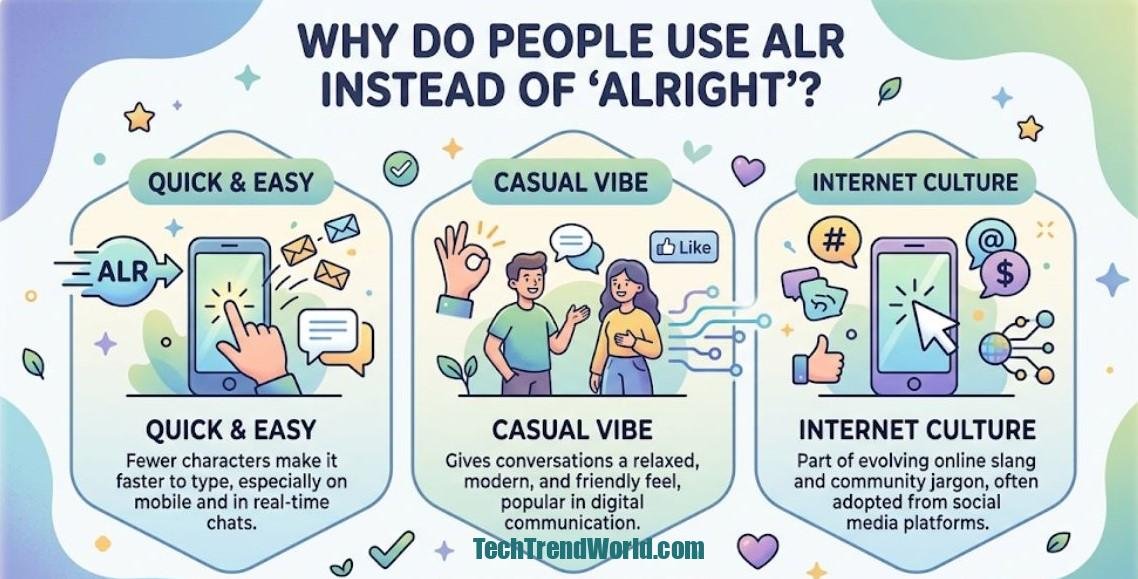
People use it to agree to a plan, confirm they received information, or transition to a new topic. It functions exactly like “okay,” “sounds good,” or “got it.” In an era where typing speed matters, dropping the vowels and extra consonants helps users fire off a reply in a fraction of a second.
While it originated in early SMS texting when character limits were strict, alr saw a massive resurgence with Gen Z on platforms like TikTok and Snapchat. Today, it is a staple of the modern digital dictionary.
The 4 Main Contexts of ALR
Understanding the dictionary definition is only half the battle. To truly master the alr meaning in text, you need to understand the social context. Here are the four primary ways people use this abbreviation.
1. Simple Agreement (The Green Light)
Most of the time, this abbreviation is a harmless confirmation. If someone asks you a question and you want to say yes quickly, this is your go-to response.
- Friend: “Are we still meeting at the coffee shop at 4?”
- You: “alr see you there”
2. The Passive-Aggressive Dismissal
Texting lacks vocal inflection. Because of this, short answers can sometimes feel cold. If someone uses this abbreviation during an argument, they might be shutting down the conversation.
- Partner: “I can’t make it to dinner tonight, I’m too tired.”
- You: “alr.” (Translation: I am annoyed, but I am not going to argue about it.)
3. The Topic Transition
Sometimes, people use this word to change the subject or wrap up a conversation. It acts as a bridge between two different thoughts.
- Coworker: “alr, let’s move on to the next project.”
4. The Check-In
Occasionally, it is used as a question to ask if someone is doing well, acting as a shortened version of “Are you alright?”
- Friend: “You left the party early, alr?”
How Punctuation Changes the Vibe
In digital communication, punctuation acts as your tone of voice. The way you punctuate this three-letter word completely alters its meaning.
- “alr” (Lowercase, no punctuation): Casual, relaxed, and standard. This is the most common and safest way to use the term.
- “ALR” (All caps): Enthusiastic or loud. This shows excitement. Example: “ALR LET’S GO!”
- “alr.” (With a period): Serious, blunt, or angry. Adding a period to a one-word text is a known sign of digital frustration. Use this with caution.
- “alr…” (With an ellipsis): Hesitant or skeptical. You are agreeing, but you have doubts. Example: “alr… if you say so.”
- “alr?” (With a question mark): Checking in. Asking if a situation or a person is okay.
ALR vs. Other Affirmative Slang
How does this term stack up against other popular ways to say “okay”? Let’s look at a comparison.
| Slang Term | Meaning | Tone & Vibe | Best Used For |
| ALR | Alright | Casual, modern, slightly detached. | Quick agreements with friends. |
| Bet | Absolutely / Yes | Highly enthusiastic, confident. | Confirming exciting plans. |
| K | Okay | Extremely blunt, often perceived as rude. | Shutting down a conversation. |
| Aight | All right | Relaxed, urban, very casual. | Chill agreements. |
| Sounds good | I agree | Polite, professional, warm. | Work emails or talking to elders. |
As you can see, alr sits right in the middle. It is more modern than “okay,” less aggressive than “K,” and less enthusiastic than “Bet.”
Pros and Cons of Using ALR
Should you add this abbreviation to your daily vocabulary? Consider these advantages and disadvantages before you hit send.
Pros
- It saves time: Typing three letters is faster than typing seven.
- It sounds natural: It shows you are up-to-date with current digital trends.
- It is versatile: You can use it to express multiple emotions depending on the emojis or punctuation you pair it with.
Cons
- It can cause confusion: Older generations might not understand what it stands for.
- It can seem dismissive: If used at the wrong time, it might make you look like you do not care about the conversation.
- It is strictly informal: Using it in professional settings is highly inappropriate.
The Evolution of Text Slang
To fully grasp the alr meaning in text, it helps to look at why we abbreviate words in the first place.
During the late 1990s and early 2000s, mobile phones used T9 predictive text. Users had to press the number pad multiple times just to type a single letter. Furthermore, SMS messages were capped at 160 characters. If you went over the limit, you were charged for a second text message.
This technological limitation birthed abbreviations like LOL, BRB, and TTYL. People had to shorten words to save time and money.
Today, smartphones feature full QWERTY keyboards, autocorrect, and unlimited texting plans. We no longer need to abbreviate words. However, the habit stuck. Today, shortening words is about efficiency, conversational flow, and group identity. Using modern slang like alr signals to the recipient that you understand the unspoken rules of internet culture.
How Different Generations View ALR

Language evolves rapidly, and the digital divide between generations is often most visible in text messages.
Gen Z (Born 1997–2012)
For Gen Z, this abbreviation is a daily staple. It is a completely neutral filler word. They will use it to confirm plans, react to a TikTok video, or acknowledge a meme. To them, typing out the full word “alright” actually feels too formal or serious.
Millennials (Born 1981–1996)
Millennials generally understand the term, though they might not use it as frequently as Gen Z. They are more likely to use “okay,” “kk,” or “sounds good.” A millennial might read a standalone “alr” as slightly dry or unenthusiastic.
Baby Boomers & Gen X (Born before 1980)
Older users frequently struggle with newer text abbreviations. If you send “alr” to your parents or grandparents, they might assume it is an autocorrect mistake, or they might ask you what it means. When texting older generations, it is always safer to spell out the whole word.
Platform-Specific Usage
Does the meaning change depending on the app you are using? Surprisingly, yes. The context of the platform dictates the flavor of the word.
TikTok and Instagram Reels
In the comment sections of short-form video platforms, users often type “alr bro” or “alr then.” Here, the term is highly reactive. It usually indicates amusement, slight disbelief, or a reaction to someone doing something embarrassing (often paired with the skull emoji 💀).
Snapchat
Snapchat is built for rapid-fire, temporary communication. On this platform, the term is used for maximum efficiency. If someone sends a photo of their outfit for a party, returning a quick “alr” means you approve and have seen the message.
iMessage and SMS
In standard text messaging, the word serves its most traditional purpose: logistics. It is the ultimate utility word for confirming times, locations, and simple questions.
Work Communication (Slack, Teams, Email)
Do not use this abbreviation at work. In a professional environment, typing “alr” to your boss or a client looks lazy and unprofessional. Stick to “Understood,” “Will do,” or “Sounds great.”
How to Respond to ALR
Many people freeze up when they receive a short, one-word text. If someone hits you with an “alr,” how do you keep the conversation going? Here are a few ways to handle it.
- You do not have to respond.
Often, this abbreviation is a conversation ender. If you just finalized plans, an “alr” is the digital equivalent of a nod. You can simply lock your phone and walk away.
- Send an Emoji.
If you want to acknowledge their message without starting a new topic, “like” their text (if your phone allows text reactions) or send a thumbs-up (👍) or a smiling face (😊).
- Change the subject.
Since the previous topic has been acknowledged and wrapped up, you have a clean slate to bring up something entirely new.
Frequently Asked Questions (FAQs)
Here are some of the most common questions people ask when trying to figure out the alr meaning in text.
1. What does ALR mean on TikTok?
On TikTok, it means “alright.” However, users frequently use it in the comment section in a slightly sarcastic or judgmental way, such as “alr bro,” when reacting to a cringeworthy or funny video.
2. Is ALR considered rude?
By default, no. It is a neutral term. However, if it is used in response to a long, emotional, or detailed text message, it can come across as highly dismissive, cold, and rude. Context is everything.
3. Can I use ALR in a professional email?
No. You should avoid using casual slang in professional settings. Instead of this abbreviation, use phrases like “Understood,” “Sounds good,” or “I agree” when speaking with bosses, clients, or colleagues.
4. What does “alr bet” mean?
“Bet” is a slang term for “yes” or “absolutely.” When combined, “alr bet” means “Alright, absolutely.” It is a highly enthusiastic way to agree to a plan or a challenge.
5. Does ALR mean already?
While some people occasionally try to use it as an abbreviation for “already,” this is highly uncommon and usually incorrect. 99% of the time, it stands for “alright.”
6. How do you respond to ALR?
You usually do not need to respond. It acts as an acknowledgment or a conversation closer. If you feel the need to reply, a simple thumbs-up emoji or a text reaction is more than enough.
7. Is ALR exclusively a Gen Z term?
While it is most heavily used by Gen Z and younger generations, many millennials have adopted it as well. However, you will rarely see Boomers or older Gen X individuals using it.
8. What is the difference between ALR and Aight?
Both mean “alright.” “Aight” is a phonetic spelling of how the word sounds in casual, spoken conversation, giving it a very relaxed vibe. “ALR” is simply a typing shortcut to save time.
9. Does capitalization matter for ALR?
Yes. Typing “alr” in lowercase is casual and relaxed. Typing “ALR” in all capital letters implies shouting, high energy, or extreme enthusiasm.
10. What does ALR mean in gaming?
In video game chats (like Roblox, Minecraft, or Call of Duty), players use it to quickly agree to a strategy, confirm they are ready to start a match, or acknowledge a teammate’s callout without having to stop playing to type a long sentence.
Conclusion
Understanding the alr meaning in text is essential for navigating modern digital communication. What started as a simple shortcut to dodge strict character limits has evolved into a versatile word capable of expressing agreement, transition, and even subtle sarcasm.
Remember, the key to using this abbreviation successfully lies in context and audience. Use it freely with your friends, siblings, and gaming buddies to save time and keep the conversation flowing. However, pay attention to your punctuation to avoid sounding accidentally passive-aggressive, and always switch back to full words when texting your boss or your grandparents.
Now that you know exactly what this popular slang means, you can confidently type it, read it, and respond to it without second-guessing yourself. Alr?