
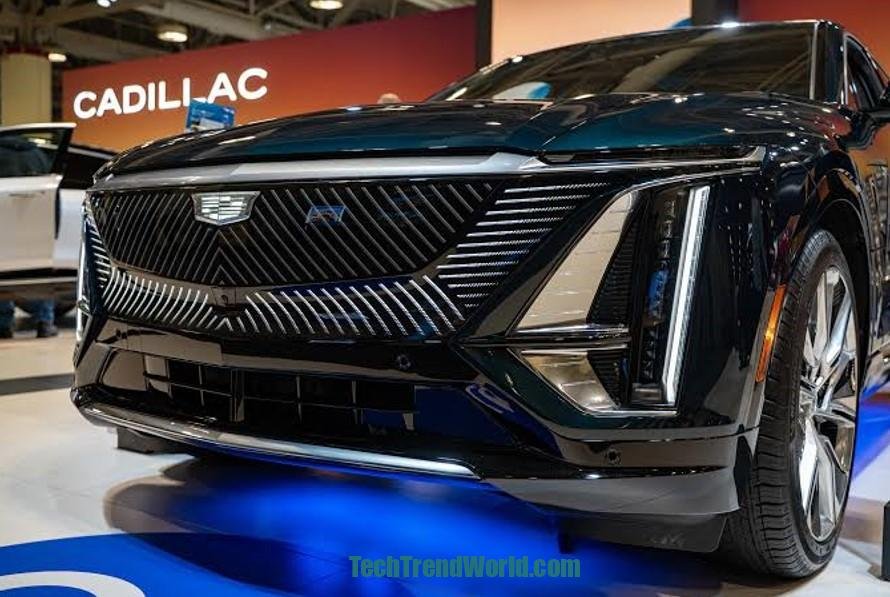
As electric vehicles (EVs) continue to dominate the luxury automotive market, maximizing battery efficiency has become a top priority for drivers. The Cadillac Lyriq stands out as a premium electric SUV, offering a blend of striking design, advanced technology, and a robust battery architecture. However, many new owners and prospective buyers frequently ask a critical question: do the driving modes in Cadillac Lyriq offer different ranges or battery usages?
Understanding how your vehicle allocates power is essential for optimizing your daily commute and long-distance road trips. The Lyriq features a sophisticated software system that alters the vehicle’s driving dynamics based on driver selection. These selections directly influence how the electric motors respond to throttle inputs, how the suspension reacts, and ultimately, how electrons flow from the battery pack to the wheels.
In this comprehensive guide, we will break down the engineering behind Cadillac’s selectable drive modes. We will explore how Tour, Sport, Snow/Ice, and My Mode interact with the GM Ultium platform to alter energy consumption. By the end of this article, you will know exactly how to leverage your Lyriq’s software to achieve peak efficiency or maximum performance, depending on your needs.
Understanding the Cadillac Lyriq Powertrain and Battery
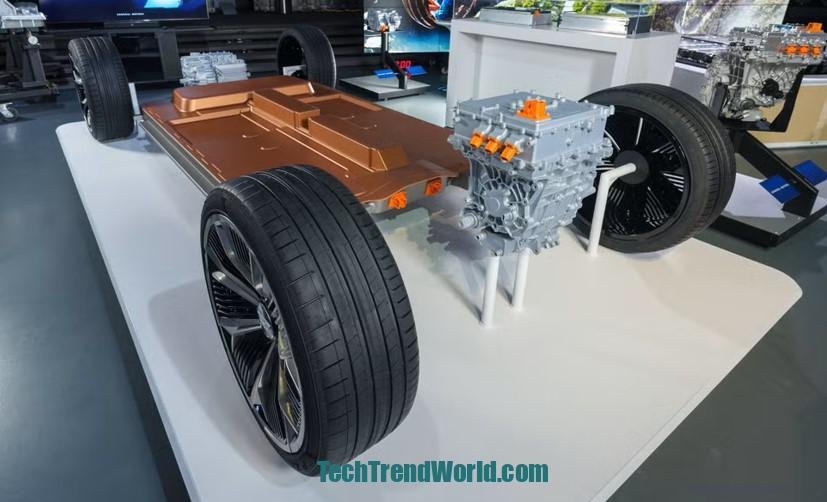
Before analyzing specific driving settings, we must understand the hardware powering the vehicle. The Cadillac Lyriq is built on General Motors’ revolutionary Ultium battery platform. This modular architecture allows for high energy density and efficient thermal management.
The Ultium Advantage
The Lyriq utilizes a large lithium-ion battery pack with a usable capacity of roughly 102 kilowatt-hours (kWh). This massive energy reserve is responsible for delivering the EPA-estimated range of up to 314 miles for rear-wheel-drive (RWD) models and slightly less for all-wheel-drive (AWD) variants.
Motor Configurations
Cadillac offers the Lyriq in two distinct powertrain layouts. The RWD model features a single permanent magnet electric motor mounted on the rear axle, producing 340 horsepower. The AWD version adds a second motor to the front axle, bumping the total output to a robust 500 horsepower. Because the AWD model carries extra weight and utilizes two motors, its baseline energy consumption is inherently higher than the RWD version.
Battery Thermal Management
A crucial component of the Ultium system is its active thermal management. The battery performs best when kept within an optimal temperature window. The vehicle expends energy to heat or cool the battery pack. While driving modes primarily affect motor output and throttle response, the underlying thermal management system operates constantly to protect battery health, taking a baseline cut of your overall range regardless of how you drive.
How Driving Modes Impact EV Efficiency Overall
In an internal combustion engine (ICE) vehicle, driving modes adjust transmission shift points and fuel injection mapping. In an electric vehicle like the Lyriq, the mechanics are entirely different. EVs lack traditional multi-speed transmissions; instead, driving modes modify software algorithms that dictate electrical current flow.
Throttle Mapping and Current Draw
When you press the accelerator pedal in an EV, a computer determines how much electrical current to pull from the battery and send to the inverters, which then power the motors. An aggressive drive mode (like Sport) features a steep throttle map. Pressing the pedal 10% might request 30% of the motor’s total power. This sudden surge of current generates heat and consumes energy rapidly. Conversely, an eco-focused mode uses a shallower throttle map, ensuring a slow, steady power draw that preserves battery life.
Steering and Suspension Resistance
Many modern EVs, including the Lyriq, feature variable-effort electronic steering and adaptive suspension systems. Firmer steering and stiffer suspension damping require slightly more electrical energy to operate the actuators and pumps. While this energy draw is minimal compared to the propulsion motors, it still factors into the overall battery usage equation.
Auxiliary Systems Integration
In some electric vehicles, eco-modes aggressively restrict the climate control system (HVAC) to save power. They might reduce the air conditioning compressor speed or limit the cabin heater. While the Lyriq’s primary drive modes focus heavily on driving dynamics, the vehicle’s software constantly monitors auxiliary power draw to provide an accurate range estimation on the dashboard.
Deep Dive into Cadillac Lyriq Driving Modes
Cadillac has engineered the Lyriq with a specific suite of drive modes designed to cater to various road conditions and driver preferences. Accessible via the center infotainment display, these modes instantly alter the vehicle’s personality.
Tour Mode
Tour Mode is the default setting every time you start the Lyriq. It is engineered for everyday driving, commuting, and highway cruising.
- Throttle Response: Linear and predictable. It provides smooth acceleration without unnecessary power spikes.
- Steering & Suspension: Tuned for maximum comfort, absorbing road imperfections effortlessly.
- Efficiency: This is the baseline for the EPA range estimates. Driving smoothly in Tour Mode is the best way to achieve the advertised 300+ miles of range.
Sport Mode
Sport Mode transforms the luxury cruiser into a more dynamic performer.
- Throttle Response: Highly sensitive. The pedal map is steepened, meaning a small press delivers a significant rush of torque.
- Steering & Suspension: The electronic steering becomes heavier, requiring more effort but providing better road feedback. The adaptive suspension stiffens to reduce body roll during cornering.
- Efficiency: Because it encourages rapid acceleration and heavier current draws, Sport Mode is the least efficient setting for daily driving.
Snow/Ice Mode
Designed specifically for inclement weather, Snow/Ice Mode prioritizes traction over outright speed.
- Throttle Response: Severely dampened. If you press the pedal hard, the vehicle intentionally limits torque delivery to prevent the tires from spinning on slippery surfaces.
- Traction Control: Hyper-vigilant, actively managing power distribution to the wheels with the most grip.
- Efficiency: Interestingly, because it forces the driver to accelerate slowly, it can be highly efficient in terms of motor draw. However, cold weather physics usually negate these savings.
My Mode
My Mode is the customizable option. It allows the driver to mix and match settings. For example, you can select the soft, comfortable suspension tuning of Tour Mode, but pair it with the heavy steering and sharp throttle response of Sport Mode. The efficiency impact here depends entirely on how you configure the parameters.
Do the Driving Modes in Cadillac Lyriq Offer Different Ranges or Battery Usages?
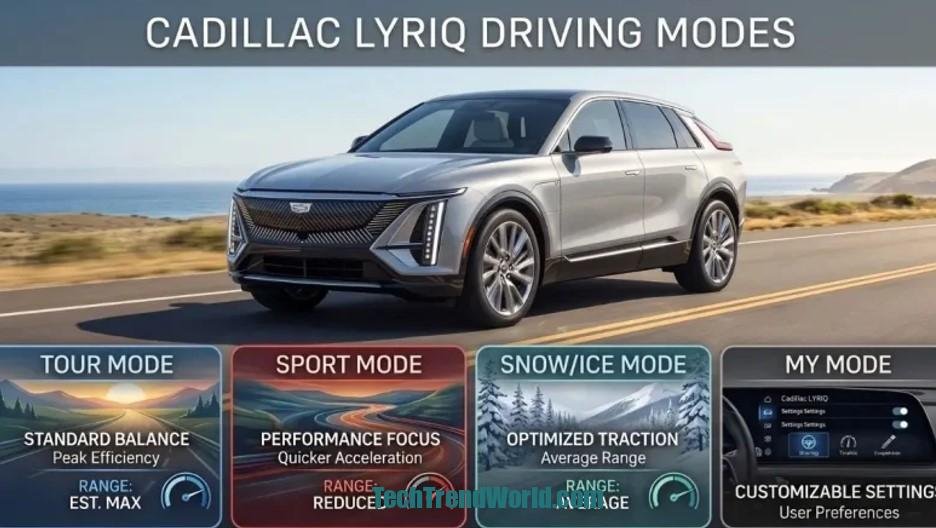
To directly answer the core question: Yes, the driving modes in Cadillac Lyriq do offer different ranges and battery usages, but primarily through behavioral influence rather than hard software range capping.
Unlike some EVs that feature a dedicated “Eco Mode” which physically restricts top speed and limits climate control to artificially extend range, the Lyriq relies on throttle mapping to influence battery usage.
The Physics of Range in Different Modes
When you drive in Sport Mode, the vehicle is not inherently wasting energy while coasting. However, the aggressive throttle mapping makes it extremely difficult for a human driver to accelerate smoothly. Every time you tap the pedal in Sport Mode, the Ultium battery dumps a larger amount of current to the motors than it would in Tour Mode. These frequent, high-amperage power surges generate excess heat in the battery and inverters. Heat is wasted energy. Consequently, driving in Sport Mode will drain your battery faster and reduce your overall range, even if you attempt to drive conservatively.
Conversely, Tour Mode naturally restricts the sudden surge of electrons. By smoothing out the power delivery, the vehicle operates in a more efficient electrical state. Snow/Ice Mode acts as an extreme version of this. By deliberately retarding torque delivery to prevent wheel spin, it forces a hyper-conservative power draw. In a controlled environment, Snow/Ice mode would yield excellent battery range. However, since you only use this mode in freezing temperatures—which inherently degrade battery performance—you will never see peak range figures while using it.
The Role of Regenerative Braking and One-Pedal Driving
While drive modes dictate how energy leaves the battery, regenerative braking dictates how energy returns to it. This is arguably more important for range optimization than the drive mode itself.
What is Regenerative Braking?
Instead of relying solely on friction brakes (brake pads and rotors), electric vehicles use their electric motors as generators to slow the vehicle down. When you lift your foot off the accelerator, the motor reverses its function, converting the vehicle’s kinetic energy back into electrical energy, which is fed directly back into the Ultium battery.
One-Pedal Driving in the Lyriq
The Cadillac Lyriq features robust One-Pedal Driving capabilities. This setting can be toggled on or off independently of the main drive modes (Tour, Sport, etc.). When engaged, lifting off the accelerator applies strong regenerative braking, often bringing the vehicle to a complete stop without the driver ever touching the brake pedal.
- High Regen Setting: Captures maximum kinetic energy. This is phenomenal for stop-and-go city traffic and can significantly extend your range.
- Normal Regen Setting: Mimics the coasting feel of a traditional gas car. It captures less energy but provides a more familiar driving experience.
The Regen-on-Demand Paddle
Cadillac also includes a unique feature: the Regen-on-Demand paddle located on the back of the steering wheel. Pulling this paddle applies regenerative braking proportionally to how hard you pull it. Skilled drivers can use this paddle in conjunction with Tour Mode to maximize battery usage, coasting when efficient and harvesting energy manually when stopping is required.
Real-World Factors Influencing Lyriq Range
While drive modes are important, they are only one piece of the efficiency puzzle. Several external factors have a much more drastic impact on the Cadillac Lyriq’s battery usage than whether you are in Tour or Sport mode.
Aerodynamics and Speed
Wind resistance increases exponentially with speed. Driving your Lyriq at 80 mph on the interstate will drain the battery significantly faster than driving at 55 mph on a rural highway. Even in the ultra-smooth Tour Mode, high speeds will decimate your range. Keeping speeds reasonable is the number one way to preserve battery life.
Ambient Temperature
Lithium-ion batteries hate the cold. Freezing temperatures increase the internal resistance within the battery cells, meaning less energy is available to move the car. Furthermore, heating the cabin relies on electric resistive heaters (or heat pumps), which draw massive amounts of power directly from the battery. You will see a notable range drop in winter, regardless of using Snow/Ice mode.
Tire Selection and Pressure
The physical connection to the road matters. The Lyriq comes with aerodynamic wheels and low-rolling-resistance tires designed for EV efficiency. Switching to larger, heavier aftermarket wheels or aggressive all-season tires will increase rolling resistance and negatively impact your battery usage. Always ensure your tires are inflated to the manufacturer’s recommended pressure.
Comparison Table: Drive Modes vs. Efficiency Impact
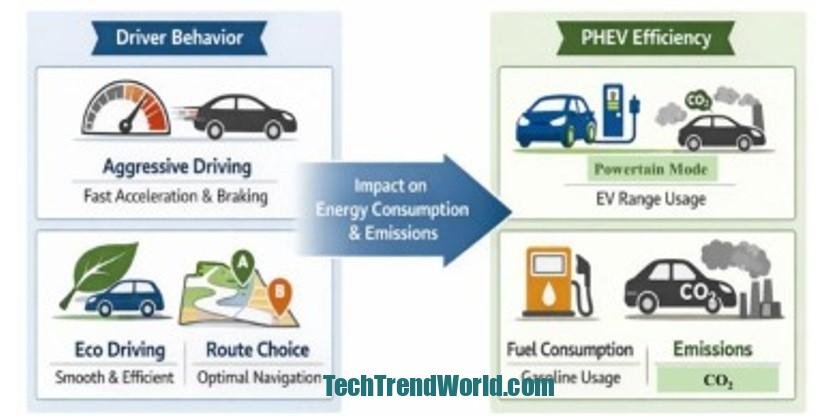
To clearly illustrate how the settings alter the driving experience and energy consumption, review this breakdown:
| Drive Mode | Throttle Mapping | Suspension Tuning | Steering Weight | Battery Efficiency Impact | Best Use Case |
| Tour | Linear & Smooth | Soft & Compliant | Light | Optimal (Baseline) | Daily commuting, highway cruising, maximizing range. |
| Sport | Aggressive & Sharp | Firm | Heavy | Reduced | Spirited driving, winding roads, overtaking. |
| Snow/Ice | Dampened & Slow | Soft | Light | Technically High (but offset by cold weather) | Winter driving, slick roads, heavy rain. |
| My Mode | Driver Configured | Driver Configured | Driver Configured | Variable | Customizing the feel to exact personal preferences. |
Pros & Cons of Using Specific Drive Modes
Understanding when to utilize each software setting ensures you get the most out of your luxury EV.
Tour Mode
- Pros: Delivers the smoothest, most luxurious ride quality. Maximizes the Ultium battery range. Predictable acceleration is great for passengers.
- Cons: Can feel slightly sluggish if you suddenly need to merge into fast-moving traffic.
Sport Mode
- Pros: Unlocks the full dynamic potential of the EV powertrain. Instant torque delivery makes the heavy SUV feel agile. Firmer suspension improves cornering confidence.
- Cons: Noticeably reduces total range due to frequent high-current power draws. Firmer ride can be uncomfortable on poorly maintained city streets.
Snow/Ice Mode
- Pros: Prevents dangerous wheel slip on icy surfaces. Creates a safer driving environment by forcing smooth pedal inputs.
- Cons: Makes the vehicle feel unresponsive on dry pavement.
Frequently Asked Questions (FAQs)
Does the Cadillac Lyriq have an Eco Mode?
No, the Lyriq does not have a dedicated “Eco Mode” that artificially limits top speed or HVAC performance. Instead, Tour Mode serves as the most efficient baseline setting for daily driving.
1. Will driving in Sport Mode damage my EV battery?
No. The battery management system (BMS) protects the battery from dangerous power spikes. However, frequently driving in Sport mode will degrade your daily range and require more frequent charging sessions.
2. How much range do I lose by using Sport Mode?
There is no fixed number, as it depends on how aggressively you press the accelerator. Generally, aggressive driving in Sport mode can reduce real-world range by 10% to 20% compared to smooth driving in Tour mode.
3. Should I use Snow/Ice mode in the rain?
You can, but it is usually unnecessary. The Lyriq’s standard traction control in Tour mode is highly advanced and capable of handling normal wet pavement. Snow/Ice mode is best reserved for actual freezing conditions or packed snow.
4. Does One-Pedal Driving save battery?
Yes. By aggressively capturing kinetic energy every time you lift off the accelerator, One-Pedal Driving extends your range, especially in city driving with frequent stops.
5. Does the AWD Lyriq use more battery than the RWD Lyriq?
Yes. The All-Wheel Drive model utilizes two electric motors and carries more physical weight. Because it takes more energy to move a heavier vehicle and power a second motor, the AWD model has slightly higher battery usage and lower overall range than the RWD version.
6. Does the Regen-on-Demand paddle replace the brake pedal?
No. While the paddle provides strong regenerative braking to slow the vehicle, the physical brake pedal must still be used for emergency stops or when maximum braking force is required.
7. Can I change driving modes while the car is moving?
Yes, you can easily switch between Tour, Sport, and other modes on the fly using the center touchscreen display without needing to stop the vehicle.
8. Does turning off the air conditioning increase range?
Yes. The HVAC system draws significant power from the high-voltage battery. Turning off the A/C or heater will instantly increase your projected range on the dashboard.
9. What is the best way to maximize range on a road trip?
Use Tour Mode, engage One-Pedal driving, keep your highway speeds below 70 mph, ensure your tires are properly inflated, and use the cabin climate control sparingly.
Conclusion
So, do the driving modes in Cadillac Lyriq offer different ranges or battery usages? The answer is a definitive yes, though the impact is driven by physics and throttle mapping rather than restrictive software caps.
General Motors has engineered the Ultium platform to be highly adaptable. By utilizing Tour Mode as your default setting, you ensure linear power delivery that protects your battery capacity and delivers the advertised 300+ miles of range. While Sport Mode unlocks the thrilling, instant torque that makes electric vehicles so enjoyable to drive, it forces high-amperage current draws that will inevitably reduce your efficiency.
Ultimately, the Cadillac Lyriq puts the power of efficiency directly in the driver’s hands. By mastering the drive mode selector, utilizing One-Pedal driving, and understanding how environmental factors impact lithium-ion chemistry, you can confidently navigate your daily commute or cross-country road trips with minimal range anxiety.
This video provides a quick visual demonstration of how to access and activate the Snow/Ice driving mode on the Cadillac Lyriq’s center display: Put Cadillac LYRIQ in Snow / Ice Driving Mode.