The New York Times has successfully captured the morning routines of millions with its growing roster of brain-teasers. While Wordle started the daily puzzle craze, Connections has quickly become the internet’s favorite categorization challenge. Every day, players stare at a grid of 16 seemingly random words, trying to group them into four sets of four. But when the grid includes words that fit into multiple categories, frustration can quickly set in.
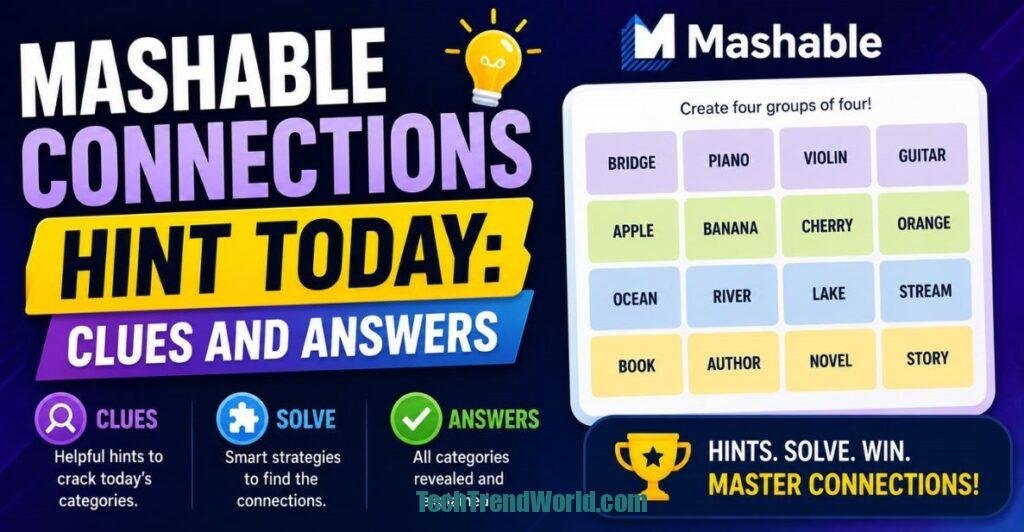
This daily struggle is exactly why the search for a Mashable Connections hint today skyrockets every single morning. Players want a nudge in the right direction without having the entire game spoiled. Mashable has perfected the art of the gentle nudge, offering structured clues that preserve the thrill of the “aha!” moment.
If you are trying to improve your daily win streak, understand how different hint sites operate, or just want to master the underlying mechanics of the game, you are in the right place. This comprehensive guide breaks down expert solving strategies, evaluates top hint providers, and explains the psychology behind the internet’s favorite word grouping game.
Before relying on external help, it helps to understand the architecture of the game. Created and edited by Wyna Liu, an associate puzzle editor at the New York Times, Connections requires lateral thinking rather than strict vocabulary knowledge.
The premise is deceptively simple: you receive a 16-word grid. Your objective is to identify four distinct categories, each containing exactly four words. You have four mistakes (or strikes) available. If you exhaust those strikes, the game reveals the answers, and your daily streak ends.
The true genius of the puzzle lies in its misdirection. The editor intentionally includes crossover words—terms that could logically fit into two or three different categories. For example, the word “BARK” could belong to a category about trees, a category about dog sounds, or a category about ships. This intentional ambiguity forces players to look at the entire board holistically rather than locking in the first group of four they spot.
Because of this built-in deception, even seasoned wordsmiths occasionally hit a brick wall. This is where daily hint guides become an essential part of the daily puzzle ecosystem.
When you type Mashable Connections hint today into a search engine, you are looking for a specific type of assistance. You do not want the answers outright; you want a lifeline. Mashable has become a preferred destination for puzzle solvers because they structure their daily articles with the player’s experience in mind.
The Staggered Hint Approach
Mashable employs a staggered, scroll-friendly format that protects readers from accidental spoilers. They understand that a good puzzle guide should act like a helpful friend sitting across the table.
Here is how they typically structure their daily guide:
- General Topic Clues: They start by simply describing what the four categories are generally about (e.g., “One category is about footwear, another is about banking”).
- Starting Letter Hints: If you scroll further, they might provide the starting letters of the words in a specific category.
- Category Names Revealed: Next, they reveal the exact names of the four categories without revealing the words inside them.
- Full Spoilers: Finally, at the very bottom of the page, they provide the complete, color-coded solution for players who are completely stuck or out of guesses.
This tiered system ensures you only consume as much help as you actually need. You remain in control of your solving experience, maintaining the dopamine rush of figuring out the final grid yourself.
Before you open a new tab to find today’s Mashable clues, try applying a few advanced strategies. Consistently beating the grid requires a tactical approach to vocabulary.
1. Utilize the Shuffle Button Constantly
The New York Times intentionally arranges the starting board to trick your brain. They will place three words related to “Water” right next to each other, alongside a fourth word that seems to fit but actually belongs to a “Things with Pitchers” category. Shuffling the board breaks these visual associations and helps your brain form new semantic connections.
2. Spot the Crossover Trap (The Rule of Five)
If you find five words that seemingly fit into one category, do not guess immediately. This is Wyna Liu’s signature trap. Instead of risking a strike, step back and look at those five words. One of them secretly belongs to a completely different, often more obscure, category. Find the other category first to naturally eliminate the imposter.
3. Look for Fill-in-the-Blanks
Not all categories are based on definitions. Many are based on wordplay. Look for words that can precede or follow a common phrase. For instance, if you see the words BLACK, STRAW, CRAN, and BLUE, your brain should immediately recognize the hidden word BERRY.
4. Work Backwards from the Purple Category
The purple category is notoriously the hardest. It rarely relies on standard definitions. Instead, it features homophones, missing letters, or phonetic tricks. If the board looks completely random, stop looking for synonyms. Start looking at the structural makeup of the words. Do they all rhyme? Do they all start with a double letter? Shifting your perspective from meaning to structure often breaks the game wide open.
A major part of the NYT Connections game is the color-coded difficulty scale. When you successfully group four words, the game highlights them in one of four colors. Understanding these tiers helps you gauge which categories to tackle first.
- Yellow (Easiest): These are usually the most straightforward, definition-based categories. They often involve direct synonyms. Think “Ways to Walk” (Stroll, Saunter, March, Strut).
- Green (Medium): This tier introduces a bit of trivia or specific knowledge. It might be “Types of Pasta” or “Countries in South America.” It requires you to know a bit about a specific subject, but the connection is still literal.
- Blue (Hard): Blue categories usually involve specialized phrasing, pop culture, or idioms. You might see “Things with a face” (Clock, Card, Mountain, Coin). The connection is conceptual rather than purely definitional.
- Purple (Tricky/Abstract): As mentioned, Purple is the wildcard. It heavily relies on wordplay. A classic example is “Words that sound like letters” (Are, Sea, Why, You).
When you check a Mashable Connections hint today, the writer will often specify which clue correlates to which color, helping you isolate the easiest groupings first and saving the dreaded purple category for your final default selection.
The internet is flooded with daily gaming guides. How does Mashable stack up against the competition? Choosing the right provider depends entirely on how you prefer to receive your clues.
Here is a breakdown of the top daily hint destinations:
| Provider | Hint Style | Spoiler Risk | Best For |
| Mashable | Tiered, staggered clues | Low (Requires scrolling) | Players who want gradual, gentle nudges. |
| Polygon | Direct category reveals | Medium | Solvers looking to quickly identify the theme. |
| Forbes | Narrative hints and tips | Low | Readers who enjoy a conversational, blog-style approach. |
| NYT Forum | Community discussions | High | Hardcore fans discussing puzzle logic post-solve. |
| Dexerto | Direct answers highlighted | High | Players with one strike left needing immediate answers. |
Mashable remains a top-tier choice specifically because of its strict formatting. The visual layout acts as a safeguard, ensuring your eyes do not accidentally catch the exact answer while you are only looking for a category hint.
Is using a hint considered cheating? In a single-player daily game, the only rules are the ones you set for yourself. However, relying on guides comes with distinct advantages and drawbacks.
Pros:
- Protects Your Streak: For many, the daily streak is a badge of honor. A gentle hint preserves that number.
- Reduces Frustration: Puzzles are meant to be fun. If you are staring at a screen for 20 minutes feeling angry, a hint restores the joy of the game.
- Teaches Game Logic: Reading daily hints actually trains your brain to understand the puzzle editor’s mindset, making you a better player over time.
Cons:
- Diminishes the “Aha!” Moment: Nothing beats the dopamine rush of cracking a near-impossible grid completely unassisted.
- Can Become a Crutch: If you look up hints too quickly, you strip away the opportunity to develop your own lateral thinking skills.
- Accidental Spoilers: Even with well-formatted sites, a slip of the thumb on your smartphone screen can reveal the answers prematurely.
Whether you solve it independently or use a Mashable guide, playing Connections daily is excellent for cognitive maintenance. Neuroscientists and educators have long praised word puzzles, and categorization games offer unique benefits beyond traditional crosswords.
Enhancing Semantic Memory

Connections heavily relies on semantic memory—your brain’s database of facts, concepts, and vocabulary. When you group words, you are actively retrieving and reinforcing the semantic links between disparate concepts. This keeps your recall skills sharp.
Boosting Lateral Thinking
Traditional crosswords are linear; you have a clue, and you find a word that fits the boxes. Connections is non-linear. It demands lateral thinking, requiring you to view a single word from multiple angles. Seeing “CRANE” as a bird, a construction vehicle, and a verb simultaneously forces your brain to remain highly flexible.
Expanding Vocabulary and Idiom Recognition
Because the NYT puzzle frequently utilizes idiomatic expressions, slang, and archaic definitions, players naturally expand their linguistic horizons. You may fail a grid because you didn’t know a specific nautical term, but you will remember that term the next time it appears.
Even seasoned players have questions about the mechanics of the game and how daily hints are sourced. Here are the most common inquiries regarding the NYT Connections puzzle.
What time does the NYT Connections puzzle reset?
The puzzle resets at exactly midnight in your local time zone. Unlike some global games that reset simultaneously worldwide, Connections rolls out at midnight wherever you are.
How early does Mashable publish their daily hints?
Because the game releases at midnight local time (meaning players in Australia and New Zealand see it hours before players in the USA), Mashable usually publishes their daily hint article well in advance of the US midnight reset. This ensures the guide is ready for early risers and night owls alike.
Who actually creates the Connections puzzle?
The puzzle is curated and edited by Wyna Liu, an associate puzzle editor for the New York Times Games division. She is responsible for the clever wordplay, misdirections, and category themes.
Is there a penalty for guessing wrong?
Yes. You are allotted four strikes per game. If you submit four incorrect groupings, the game ends, your streak is broken, and the board reveals the correct answers.
What does “One away” mean in the game?
If you submit a guess where three of the words belong to a category, but one is incorrect, the game flashes a message saying, “One away.” It will not tell you which word is the imposter, requiring you to carefully re-evaluate your selection.
Can I play past Connections puzzles?
Yes. The New York Times recently introduced an official Connections Archive for subscribers, allowing you to go back and play past puzzles you may have missed.
Why are the purple categories always so obscure?
The purple tier is intentionally designed to test structural wordplay rather than vocabulary definitions. It is meant to be the most challenging grouping, often involving fill-in-the-blanks, homophones, or hidden words within words (e.g., words that contain days of the week).
How does a site like Mashable avoid giving away answers immediately?
Publishers use clever formatting. They utilize bold headers, ample blank space, bulleted lists, and staggered scrolling. They give the category theme first, ensuring readers have a chance to guess the words before seeing the ultimate solution at the very bottom of the page.
Are there other games similar to Connections?
Yes! If you enjoy categorizing words, you might also like games like Red Herring, PuzzGrid (based on the British game show Only Connect), and the Wall Crossover puzzles.
Do I need a New York Times subscription to play Connections?
Currently, Connections is free to play for anyone via the NYT Games app or website. However, features like the official puzzle archive require a paid NYT Games subscription.
Conclution:
Navigating the daily grid does not have to be an exercise in frustration. The search for a Mashable Connections hint today is a testament to how deeply this simple word game has embedded itself into modern morning routines. Millions of people are pouring their coffee, opening their phones, and trying to decipher Wyna Liu’s daily traps.
Using a tiered hint guide is a fantastic way to bridge the gap between complete confusion and the joy of solving. By leveraging the expert strategies outlined above—shuffling the board, identifying the crossover traps, and looking for wordplay over definitions—you will likely find yourself needing those hints less and less over time.
Keep your brain sharp, protect your daily streak, and remember that when the purple category seems entirely impossible, a gentle nudge from a reliable puzzle guide is always just a click away.